In warehouses, workshops, and supermarket restocking areas, Roll Containers with casters are practically the “efficiency champions”—easy to push, flexible to turn, and quick to load and unload. But many people overlook one issue: if the wheels can roll, they can also “run away.”
On slopes, on uneven ground, or the moment a worker turns away, a Roll Container without braking devices can silently slide like a car without its handbrake pulled, hitting people, damaging goods, or crushing feet. Numerous safety incidents like this have already occurred.
So, why is a Roll Container with brake casters safer? The answer lies in that small “handbrake system.”
I. The "Hidden Slopes" on Warehouse Floors: More Than You Think
Many people think, “My warehouse floor is flat, I don’t need brakes.” But in reality, warehouses are full of invisible slopes:
Between the loading dock and the warehouse
Typically has a 1°–3° gentle slope for drainage and vehicle access
Near floor expansion joints
After long-term use, the ground develops minor undulations
Between cold storage and ambient temperature areas
Temperature differences cause condensation, making the surface slippery and sloped
Along aisle sides
Industrial floors are often higher in the center and lower on both sides for drainage purposes
These slopes are invisible to the naked eye, but a fully loaded Roll Container can weigh over 200–300 kilograms including the goods. On a 2° slope, just a tiny external force—like vibration from a passing forklift or the slight push when a worker lets go—can set it in motion.
It may start slowly, but under gravity, it accelerates. By the time the worker reacts, it’s often too late.
II. Which Work Scenarios Need "Brakes" the Most? Four Key Scenarios
Brake casters on Roll Containers aren’t necessary for every situation, but in the following types of working environments, they’re practically a “must-have”:
Scenario 1: Loading Docks and Truck Docking
Loading docks typically have a slope for vehicle access and rainwater drainage. When working at the dock edge, workers need to push Roll Containers from the warehouse onto the dock and then into the truck. During this process, the Roll Container sits right at the transition point between the dock and the truck—on a slope, with gaps underfoot, and a drop of several meters behind. Without brakes, even a slight bump or vibration could send the Roll Container sliding toward the dock edge—with disastrous consequences.
Scenario 2: Cross-Area Transfer Aisles
Many factories and warehouses have aisles connecting different functional zones—from raw material storage to production, from production to finished goods. These aisles often have gentle slopes or step transitions due to building structure requirements. Workers push Roll Containers back and forth through these aisles daily. If they need to stop midway to yield to a forklift or pedestrians, a Roll Container without brakes can only be held in place by brute force—tiring and dangerous.
Scenario 3: Around Automated Equipment
Modern warehouses are increasingly filled with automated equipment—AGVs, robotic arms, automated packing lines. These machines are expensive and require high positioning accuracy. If a Roll Container is parked near such equipment and slides—even just a few centimeters—it could hit sensors, probes, or moving robotic arms, causing equipment failure or even production stoppages.
Scenario 4: High-Density Picking Areas
In e-commerce warehouse picking zones, worker density is high, movement is frequent, and attention is fully focused on the orders at hand. A Roll Container without brakes, temporarily parked along an aisle, might be accidentally bumped by passing workers and start sliding—hitting a colleague bent over picking items. Picking zones are filled with goods ready for shipment. If a Roll Container goes out of control, the losses extend beyond just the goods—injuries are a real possibility.
III. How Does the Brake Caster (Handbrake System) Solve This Problem?
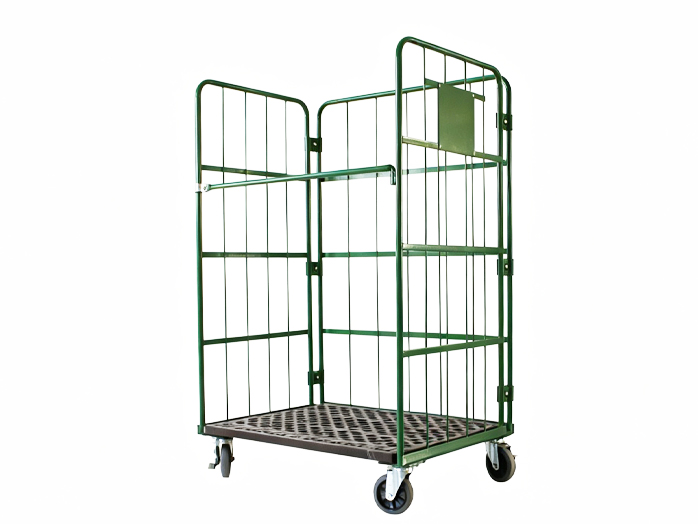
A Roll Container with brake casters essentially has a braking mechanism added to the wheels. The operator can step on or flip a lever to lock one, two, or all wheels, keeping the Roll Container firmly in place on any slope.
Specifically, there are two common types of brakes:
1. Total Brake (Full Lock)
Also called “master brake,” this locks all wheels with a single action. Step on the brake pedal and all wheels lock simultaneously—the Roll Container won’t budge. Suitable for scenarios requiring frequent stops and extremely high stability.
2. Side Brake (Directional Brake)
This locks only two of the wheels (usually the fixed-direction wheels), while the swivel casters remain free to turn. This design keeps the Roll Container from sliding on slopes while still allowing steering flexibility—ideal for slope-heavy operations.
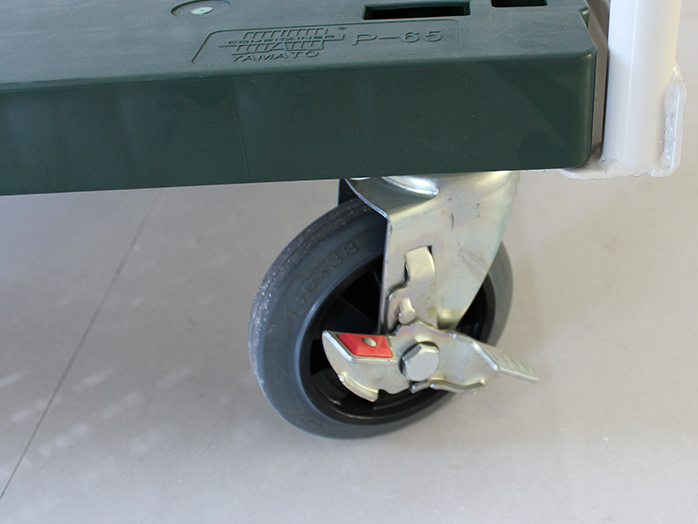
The handbrake system is usually straightforward to operate—press the pedal with your toe to brake, press again or lift to release. Some premium designs also feature a “parking lock” function that automatically locks after braking, preventing release even if someone accidentally pushes against it.
IV. Roll Container with Brake Casters: Giving Workers the Confidence to "Let Go"
The greatest value of a Roll Container with brake casters isn’t just “being able to stop”—it gives workers the right to “let go with confidence.”
Stop and step on the brake—the unit stays firmly in place, freeing the worker’s hands for other tasks;
During loading and unloading, the unit won’t suddenly slide due to uneven ground;
On slopes, workers can stop anytime to adjust their posture, without having to brace against the unit with their legs;
For temporary storage beside production lines, no need to constantly worry about the unit bumping into delicate equipment nearby.
Simply put, a Roll Container without brakes requires someone to “watch” it at all times; a Roll Container with brakes allows people to “turn around with peace of mind.”
V. Choosing Casters for Roll Containers: Brakes Are Only Part of the Equation
Beyond the braking system, the casters themselves matter. Choosing the right material and configuration further improves safety:
Caster Materials:
Polyurethane (PU) casters: Quiet, floor-friendly, wear-resistant—ideal for workshops and supermarkets where noise is a concern. They also have higher friction coefficients, working better with brakes.
Nylon casters: High hardness, strong load capacity—suitable for heavy loads and warehouses with good floor conditions.
Rubber casters: Good elasticity, strong shock absorption—suitable for uneven floors, though less wear-resistant.
Caster Configurations:
Dual-wheel design: Compared to single wheels, dual wheels offer a larger contact area and better stability, stopping more securely.
Swivel casters with foot brake: Reliable braking even in narrow aisles with frequent turns.
A professional recommendation for customers: If Roll Containers need to be used on slopes, wet floors, or in high-traffic areas, prioritize polyurethane casters with at least 2 brakes.
VI. At the End of the Day: Saving Money on Brakes Could Cost You Far More
Some buyers, looking to cut costs, consider skipping brake casters with the reasoning that “workers will be careful.” But the math doesn’t work that way:
One goods spill could mean a box of precision parts lost;
One injury to a colleague could mean workers’ compensation and production downtime;
One collision with equipment could mean thousands in repairs and production line stoppages.
Yet a handbrake system typically adds only 5%–10% to the total cost of a Roll Container. A small price to pay for the certainty that “nothing goes wrong.”
Conclusion
A Roll Container with brake casters isn’t some high-tech marvel—it’s simply a “lock” added to the wheels. But this small “lock” turns the risk of “potential sliding” into the safety of “standing firm.”
For warehouse managers, asking “Does this come with brakes?” when selecting a Roll Container is far easier than dealing with a safety incident after the fact.
A qualified Roll Container should be both easy to push AND able to stop securely. A Roll Container that can stop securely is a truly safe Roll Container.