During our communication with customers, we often receive questions about our products. Our sales team and content editors have carefully compiled some of the most common customer concerns to help you have a better purchasing experience. Below are the top 10 questions customers frequently ask about Wire Container products:
1. What is the load capacity? How many tiers can be stacked?
This is the most frequently asked question by customers. Load capacity directly affects cargo safety and product lifespan. Standard containers typically have a static load capacity ranging from 500kg to 2,000kg per unit, depending on wire diameter and structural design. For example, an 800×600mm container has a rated capacity of approximately 500kg, while a reinforced 1200×1000mm model can handle up to 2,000kg.
In terms of stacking, well-designed containers can typically be safely stacked 3-4 tiers high when fully loaded. When selecting a model, you should focus on the full-load stacking capacity rather than just the single-unit load capacity—this directly affects warehouse space utilization.
2. Can it be folded? How much space can be saved after folding?
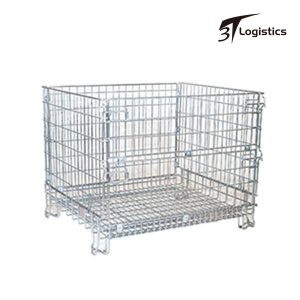
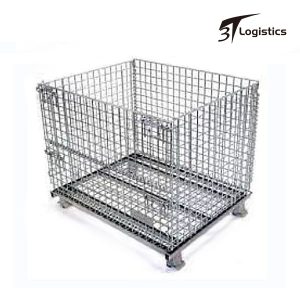
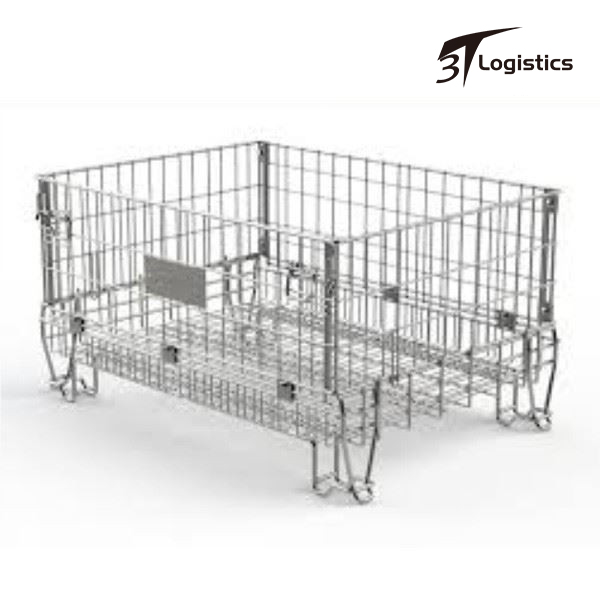
Foldability is one of the core selling points of Wire Containers. Most models feature side panels that can be folded flat onto the base. After folding, the height is greatly reduced, and the storage space required can be decreased to 1/5 or even less of the original size.
This is especially important for scenarios involving empty container return shipping or off-season storage—folded containers can significantly reduce return transportation costs and improve warehouse space efficiency.
3. What surface treatment options are available? Will it rust?
Surface treatment directly affects product lifespan and suitability for different environments. There are three common treatment options:
Electro-galvanized
Cost-effective, suitable for standard indoor dry environments
Hot-dip galvanized
Strong rust protection, ideal for humid, outdoor, or coastal high-salt environments—rust protection lifespan can reach 5 years or more
Powder coating
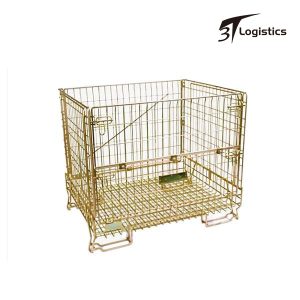
Customizable colors, suitable for food and electronics industries that require cleanliness and appearance
If your operating environment involves oil, moisture, or chemical exposure, be sure to confirm that the surface treatment’s protection level matches your needs.
4. What about mesh size and wire diameter? What's the difference?
Mesh size and wire diameter determine the container’s load capacity and protective performance. For standard containers, we recommend a minimum bottom mesh wire diameter of 6mm and side mesh of 4-5mm. For heavy-duty applications, 8mm or thicker wire is available.
Common mesh sizes are 50×50mm or 50×100mm. Tighter mesh prevents small items from falling out more effectively, while larger mesh provides better ventilation but less protection. Your selection should be based on the size of the goods being stored.
5. What's the difference between wire containers, plastic bins, and cage pallets?
This is a common point of confusion for many customers during the selection process. Here’s a comparison:
-
vs Plastic Bins: Wire containers have a lifespan of 10-15 years—3-4 times longer than plastic bins. They are 100% recyclable and more environmentally friendly. However, the initial investment is higher, making them better suited for heavy loads and frequent use scenarios.
-
vs Cage Pallets: Cage pallets are typically lighter and fold more compactly, making them suitable for light-duty short-distance circulation. Wire containers (especially the box-type structure) offer stronger load capacity and better rigidity, making them ideal for heavy loads and long-term stacking storage.
6. How does the door open? Can I access goods when stacked?
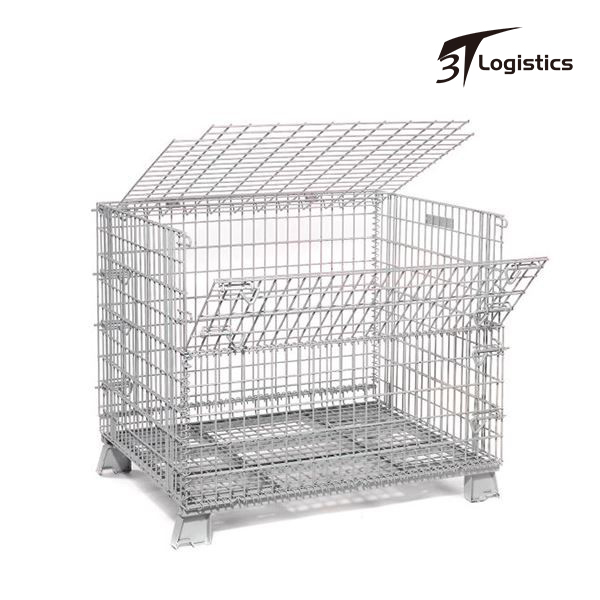
Door design directly affects operational efficiency. Common configurations include half-drop doors and full-drop doors:
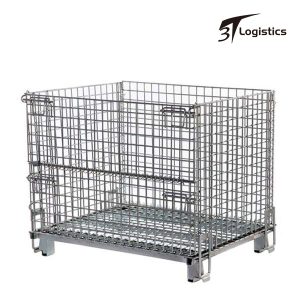
Half-drop door: Even when containers are stacked at the bottom, you can open the top half to access goods without affecting the stack above—this is the most commonly used design.
Full-drop door: Opens completely, making it convenient for loading and unloading large or bulky items.
When selecting, be sure to confirm that the door’s opening direction and locking mechanism are easy to use, and that the door can operate normally when stacked.
7. Can the base be accessed by forklift? What does 4-way entry mean?
The base design determines handling convenience. High-quality containers typically feature 4-way forklift entry pockets (U-channel or square tube base), allowing forklifts or pallet jacks to lift the container from any direction—offering great flexibility.
For scenarios requiring frequent movement, casters (PU wheels, nylon wheels, etc.) can also be added as an option, allowing you to push the container without a forklift.
8. Can sizes be customized? How does non-standard customization work?
We support non-standard customization. You can specify external dimensions, internal space, color, and more. Please note that significant changes in size may affect the container’s load capacity and stacking stability.
For custom orders, we recommend providing: goods dimensions, unit weight, number of pieces per container, and whether it needs to be compatible with existing racks/forklifts—this helps us provide accurate quotes and design solutions.
9. How can I evaluate welding quality? Does it affect lifespan?
Welding is the “backbone” of the container. Poor weld points are the primary cause of premature container failure. Good welding should feature full, evenly distributed weld points with no voids. Robotic welding offers better consistency and more stable quality compared to manual welding.
10. What's the approximate price range? What's the difference between expensive and cheaper options?
Price differences typically come from several factors: wire diameter (material cost), surface treatment process (hot-dip galvanizing costs more than powder coating), whether it’s foldable, and whether casters are included. For the same specifications, the price difference can be substantial.
The higher price often goes into things you can’t see: thicker wire, stronger welds, and thicker galvanized coating. These products have higher initial costs but offer longer lifespan and better safety. Cheaper alternatives may deform within just six months, ultimately costing you more money in the long run.
Summarize
These are some of the common questions customers frequently ask. When making your purchasing decision, we recommend that you first clarify your use scenario (What goods? How heavy? How will they be moved? Where will they be stored?), then match the product specifications (load capacity, dimensions, surface treatment, folding method), and finally weigh the balance between price and lifespan.
If you’re still unsure about your choice, feel free to contact us anytime. Our professional service team is here to answer your questions and address any concerns you may have.