I. Industry Standards and Technical Specifications
1.1 International Standards
There are clear international standards governing the roll container industry:
The EN 12674 series: This is a European standard comprising multiple parts that regulate roll containers. Specifically, EN 12674-2:2001 (also published as BS EN 12674-2:2002) establishes the fundamental design and safety principles for roll containers, covering four main types, including demountable and folding models. This standard specifies the following key design requirements:
– Method for dimensioning the roll cage’s footprint (length/width/direction of movement)
– External footprint dimensions must be marked
– Internal footprint dimensions must be marked
– External height, internal clearance height, and folded height must all be marked
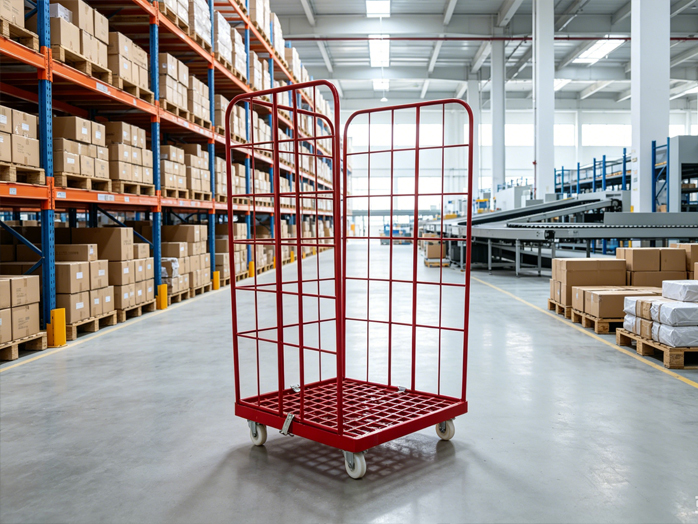
South Korean Retail Industry Standards: South Korea has developed dimensional standards for roll containers used in the retail sector. These standards require that roll container dimensions be compatible with transport packaging modules and truck body sizes, ensuring better operational fit and facilitating the establishment of a roll-container-based unit load system.
II. Analysis of Application Areas
Why Choose us
Retail is the primary application area for roll cages; you can readily find such products in supermarkets, department stores, and convenience stores. Using roll cages simplifies tasks and facilitates the transport of goods.
Store Replenishment
Transporting goods from distribution centers to stores is highly convenient, whether via short-haul or long-haul trucking.
Storefront Display
Some roll cages serve directly as display units on the sales floor, with their internal shelving offering great convenience.
Inventory Turnover
This involves the movement of goods between the back-end warehouse and the sales area—a process that requires maximizing efficiency while minimizing labor.
2.2 Logistics and Distribution
Third-party logistics (3PL) enterprises and express delivery companies make extensive use of roll cages in their operations:
Sorting centers: Serve as vital tools for order picking and sorting, enabling quick and easy transport of goods from Area A to Area B—a task that can be performed by a single person.
Last-mile delivery: Organization of cargo for delivery vehicles.
Transshipment: Transfer of goods between different modes of transport.
Participants in the roll container value chain include raw material suppliers, container manufacturers, logistics service providers, retail and supermarket chains, food and beverage producers, third-party logistics (3PL) providers, and e-commerce fulfillment centers.
2.3 Manufacturing Industry
An increasing number of manufacturing enterprises are utilizing our products. Within manufacturing intralogistics, roll cages are used for:
Component handling: Transporting parts between production lines—whether the parts are small or packed in larger containers.
Semi-finished product storage: Temporary storage between processing stages, allowing for ready transfer.
Finished product transfer: Moving finished goods from the production line to the warehouse, enabling convenient transport from point A to point B without the need for repeated manual handling.
Furthermore, driven by the rapid growth of the automotive and electronics sectors, roll cages are now widely used across industries such as automotive components, electronics, and consumer goods.
2.4 Food and Beverage Industry
The food and beverage industry has specific requirements for roll cages:
Fresh food distribution: Requires materials that are easy to clean and resistant to low temperatures, as well as products capable of handling heavy loads.
Beverage handling: Demands high load-bearing capacity, with strict standards for wheels and chassis.
Cold chain logistics: Must be suitable for low-temperature environments and meet specific requirements for salt spray resistance.
Consequently, our products are not only widely used in supermarkets, agriculture, and fisheries but are also suitable for logistics packaging, transportation, and warehousing within the food and beverage industry.
2.5 E-commerce and Express Delivery
The explosive growth of global e-commerce has created new opportunities and diverse application scenarios:
Order Fulfillment Centers: Various types and sizes of roll cages are suitable for carrying goods during picking and packing processes.
Express Delivery Hubs: Used for parcel sorting and temporary storage; different products can be placed on separate shelves for easy retrieval.
Returns Processing: These products can also be utilized for the consolidation and handling of returned goods.
2.6 Automotive Industry
In modern society, the automotive industry is a key sector for the application of roll cages:
Component Supply Chain: Transport of parts from suppliers to OEMs (Original Equipment Manufacturers)
Aftermarket Parts: Warehousing and distribution of various automotive components
Production Line Supply: Material distribution between workstations on the production line