In warehouse management, loose materials—such as hardware parts, auto components, electronic elements, and various small merchandise—have always been a headache. They come in many varieties, with mixed quantities, are easy to lose, and hard to find. Many companies have tried using cartons, but due to the weight of some parts, the cartons easily deform under pressure. Plastic bins? Stack them high and they become unstable. Put them directly on pallets? The goods scatter all over, and inventory counting becomes a nightmare.
So is there a storage solution that can solve all these problems at once? Cage Pallet is worth a serious look. It’s not some complicated new invention, but it happens to be the most handy “weapon” for dealing with loose materials.
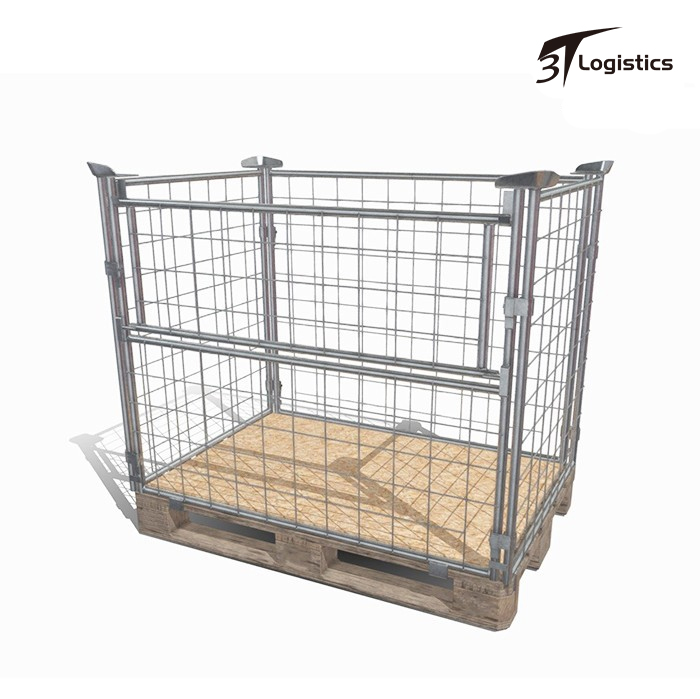
I. Mesh Cage Body: Everything Inside Is "Crystal Clear"
What’s the biggest pain point when handling loose materials? You can’t see them, you can’t find them.
Once a carton is sealed, nobody knows what’s inside or how many are left—unless you open it. When you’re dealing with a wide variety of parts in many specifications, just rummaging through boxes can waste a tremendous amount of time.
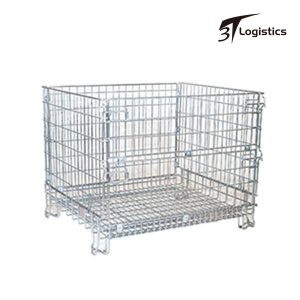
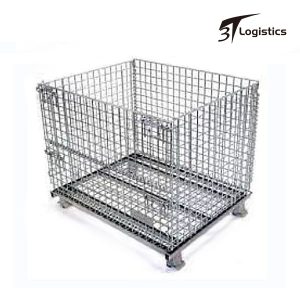
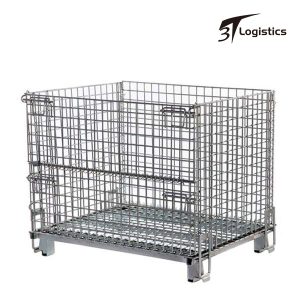
Cage Pallet takes a straightforward approach: using high-strength steel wire welded into a mesh cage body, with surrounding fences and reinforced bottom crossbeams. The structure itself provides clear visibility—the goods inside are visible to the naked eye, allowing you to identify the type and estimate the quantity without opening anything.
This is extremely friendly for daily inventory counting. Warehouse staff can directly confirm the contents through the mesh, saving the hassle of repeatedly opening cartons to check. For industries like auto parts and hardware that require frequent stocktaking, this design is a huge help.
II. Stackable and Foldable: Making the Most of Warehouse Space
Warehouse space is never enough—this is a universal truth for warehouse managers. If loose materials are spread out on the floor, no amount of space will ever be sufficient.
The standardized dimensions of Cage Pallet (common sizes like 1200×1000mm and 1000×800mm) make it easy to fit into mainstream racking systems, enabling multi-tier stacking and making full use of vertical space. A well-designed cage pallet can be stacked up to 4 tiers when fully loaded, maximizing vertical storage capacity.
Even more noteworthy is its foldable design. When empty, the folded height is only 1/4 to 1/5 of its original size, allowing multiple folded cage pallets to be compactly stacked together without taking up much space. This means during off-seasons, they won’t waste valuable warehouse floor space.
For loose materials, this ability to flexibly switch between “expanded for use” and “folded for storage” extracts every bit of value from your warehouse space.
III. Whole-Cage Handling: "Zero Transshipment" Efficiency
Another challenge with loose materials is turnover efficiency. Moving cartons or bulk materials around the warehouse often involves repeated handling—from shelf to cart, from cart to truck—with labor costs at every step.
One of Cage Pallet’s core functions is “storage and transport integration”: once goods are loaded into the cage pallet, they can go directly into racking for storage. When it’s time for outbound shipping, a forklift or pallet jack picks up the entire cage and goes—no need to unload and reload the goods.
This is what we call “whole-cage handling”—goods stay inside the cage from receiving to shipping, without unnecessary handling. This is especially valuable for loose materials, because moving small items one by one is painfully inefficient, while moving a whole cage transfers dozens or even hundreds of pieces at once.
Additionally, the bottom design of cage pallets is typically compatible with forklifts, pallet jacks, and other equipment, with four-way entry for maximum operational flexibility.
IV. Sturdy and Durable: Not Delicate, Resists Oil and Moisture
Among loose materials, hardware parts carry oil, auto components collect dust, electronic parts fear moisture… if the packaging material isn’t up to the job, damaged goods are a daily occurrence.
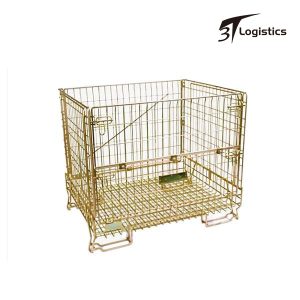
Cage Pallet is welded from steel and finished with galvanization or electrostatic powder coating, making it oil-resistant and rust-proof. It can hold up in oily workshop environments or damp warehouses. Compared to cartons that soften when damp or plastic bins that crack under pressure, metal-structured cage pallets last much longer.
Moreover, the cage body itself provides a layer of physical protection: mesh fences prevent goods from falling out, and reinforced bottom beams prevent deformation under pressure. When loose materials are stored in a cage pallet, they won’t scatter all over the floor, nor will they be easily crushed.
V. More Than Just a "Cage": An All-Rounder from Storage to Circulation
A storage unit on racking
Placed directly into beam racking as a replacement for pallets + cartons, making classification clearer
An extension of the workbench in picking zones
Rolled to the picking area where staff can retrieve items directly from the cage, reducing unnecessary walking
A circulation container beside production lines
With casters added, it moves easily between different workstations
A packaging solution for long-haul transport
Meeting international shipping standards, it can be loaded directly into shipping containers as a replacement for single-use packaging.
Conclusion
Loose materials have never been a “small problem”—if not managed properly, they become a big headache. The value of Cage Pallet lies in its simple, standardized, and durable solution that connects the key links of “storage, circulation, protection, and inventory counting,” bringing order and efficiency to loose material management.
If your warehouse also has these small items that never seem to stay organized, consider giving them a Cage Pallet—the right partner can make a world of difference.