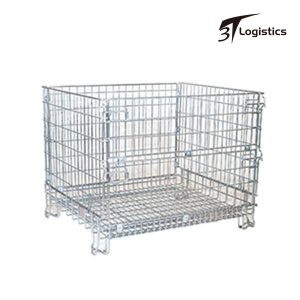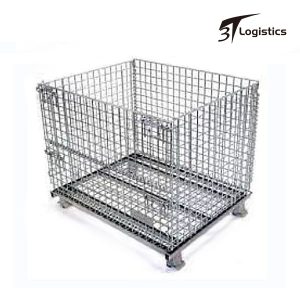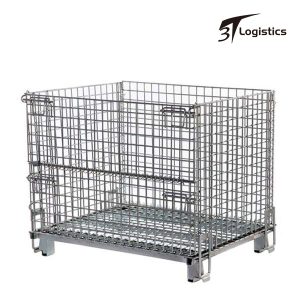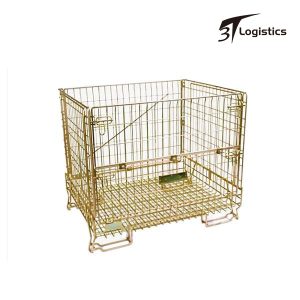
In warehouses and workshops, Wire Containers are a common sight—sturdy, breathable, and offering clear visibility of the contents. But when it comes to purchasing, many people get stuck on one question: Should I buy the ones without casters (fixed) or with casters (mobile)?
It may seem like just a few wheels, but choosing wrong can lead to either something that’s impossible to move or something that moves when it shouldn’t—making everyday use frustrating. Based on years of industry experience, this guide will help you clarify your selection process from multiple perspectives.
I. What's the Real Difference Between Fixed and Mobile?
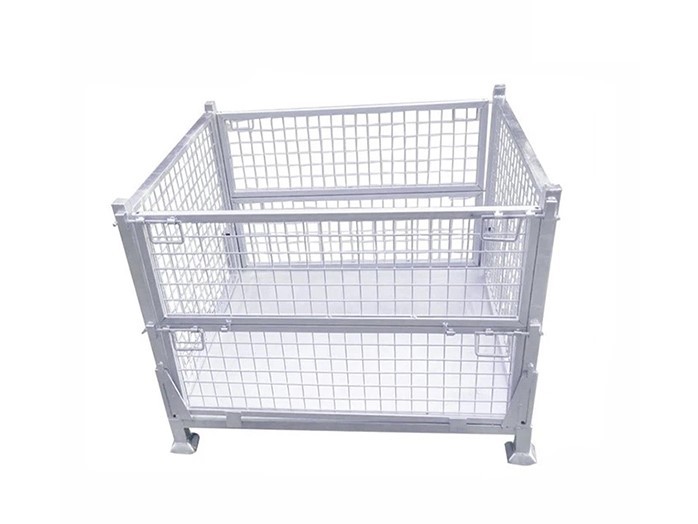
Fixed Wire Container
No wheels installed on the bottom. It sits directly on the floor or on a pallet for forklift use. When movement is needed, a forklift or pallet jack must lift the entire container to relocate it. The structure is simpler, the price is relatively lower, and load capacity is typically stronger.
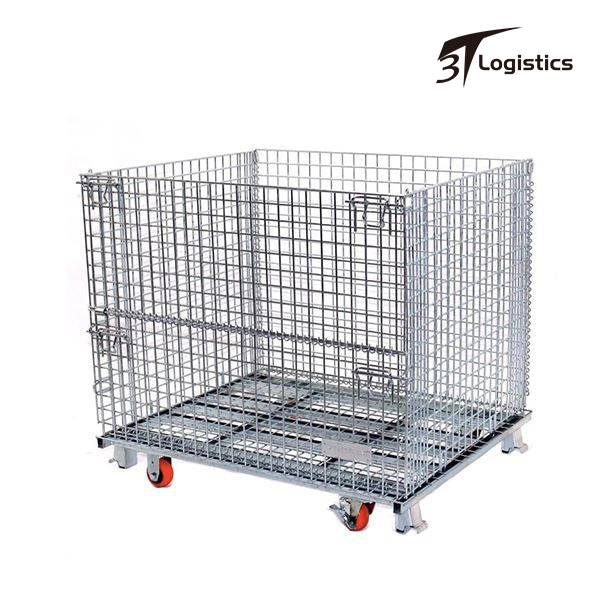
Mobile Wire Container
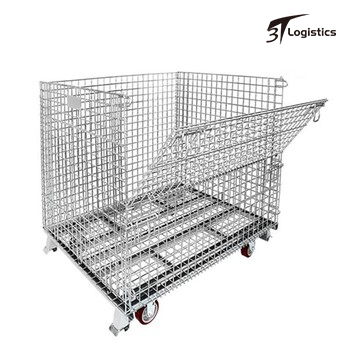
Equipped with casters on the bottom (usually 2 fixed-direction casters + 2 swivel casters), allowing workers to push it around like a hand truck. For short-distance transfers, no forklift is needed—greatly improving flexibility. Some models also come with brakes to lock the wheels when stopped on slopes or uneven ground.
II. When to Choose Fixed: Goods Stay Put, or Move in Bulk Batches
In the following situations, a fixed Wire Container is the better choice:
1. Long-term stationary storage with infrequent movement
If your Wire Container is mainly used for “static storage”—such as sitting on racking, stacked in a warehouse corner, or as a raw material staging area beside production lines—then fixed is perfectly adequate. Once goods are loaded, they won’t be moved for a long time, until the entire container is emptied or shipped out.
In this case, adding wheels is completely unnecessary. It only adds cost and ongoing maintenance hassles (wheels wear out, get tangled with debris, and require periodic inspection).
2. Integrated pallet transfer with forklifts or pallet jacks
The wooden material do have more than 10 kinds for common using, oak, pine, poplar, birch or any other kinds of wood are all can be chosen from us. Different wood materials do have its special feature, we have to knowing each of the features to make a high quality moulding with these wooden materials, but the price will be very different for each type of wood.
3. Heavy loads or high stacking
If Wire Containers need to be stacked (especially when fully loaded), fixed has a clear advantage. Without wheels, the bottom is a flat, even support surface that distributes weight more evenly and provides greater stability during stacking. Stacking mobile containers requires the wheels to bear enormous pressure, demanding exceptionally high wheel quality. If one wheel fails, the entire stack risks toppling. Therefore, if you need to stack 3 tiers or higher, fixed is usually the priority.
4. Less-than-ideal floor conditions
If your warehouse floor has significant bumps, cracks, or is made of a material not suitable for rolling (like soft flooring or carpeted areas), mobile containers are hard to push and wheels are prone to damage. In such environments, fixed containers paired with forklift handling are more reliable.
III. When to Choose Mobile: Goods Need to "Follow the Worker"
In the following situations, mobile Wire Containers are more convenient:
1. Sorting, order picking, and restocking operations
In e-commerce warehouses, distribution centers, and supermarket backrooms, workers need to push Wire Containers through aisles between racks, placing picked items into them one by one. Once the container is full, they push it directly to the packing or shipping area. Throughout this process, the Wire Container “follows the worker” and is constantly on the move—without wheels, the job becomes nearly impossible.
2. Material delivery beside production lines
On the workshop floor, materials need to be delivered from raw material storage to individual workstations. Workers push fully loaded Wire Containers to the production line, where operators take parts directly from them. Empty containers are then pushed back to the warehouse to be refilled. In this “delivery → usage → return” cycle, wheels are a must.
3. Frequent repositioning needed
If Wire Containers need to move frequently between different areas—from receiving to inspection, from inspection to temporary storage, from temporary storage to shipping—mobile saves the hassle of repeatedly finding a forklift, securing loads, and hoisting. A single worker can easily push them around, significantly improving efficiency.
4. Narrow aisles with limited forklift access
Some warehouses have narrow aisles and tight rack spacing, making forklift maneuvering difficult or even impossible. In these environments, compact and agile mobile Wire Containers can be pushed directly through, reaching corners that forklifts can’t access.
5. High product variety with small batch sizes
If your materials are characterized by “many batches, small quantities per batch,” requiring frequent access and swapping of different containers, mobile allows a single worker to easily manage multiple containers—push one, pull another—with great flexibility.
IV. An Often-Overlooked Point: Mixed Configuration Is the Smartest Approach
Common configuration strategies include:
Primarily fixed, supplemented by mobile
Most Wire Containers are used for static storage, fixed on racking or in stacking areas. A small number of mobile units are used for “flow restocking”—transferring goods from fixed storage into mobile containers, then pushing them to production lines or picking areas.
Fixed on the bottom, mobile on top?
Some special scenarios reverse this—bottom containers are fixed because they bear more weight, while upper containers are mobile because they need frequent access. However, this is less common and depends on specific rack configurations.
V. If You Choose Mobile, How to Pick the Right Casters?
The “soul” of a mobile Wire Container lies in its casters. Wrong casters mean hard pushing, loud noise, and short lifespan. Key points to consider:
Material
Polyurethane (PU) casters: Top recommendation. Quiet, floor-friendly, wear-resistant—suitable for the vast majority of warehouse and workshop scenarios.
Nylon casters: High hardness, strong load capacity—good for heavy loads, but louder when pushing and require smooth floors.
Rubber casters: Good elasticity, strong shock absorption—suitable for uneven floors, but less wear-resistant and prone to deformation over time.
Brakes
If your Wire Containers will be used on slopes, loading docks, or high-traffic areas, equip at least two wheels with brakes. Step on the brake when parked—the container stays rock-solid.
Load Capacity
The caster’s load capacity should match the Wire Container’s maximum weight. A good rule of thumb: choose casters with a load rating ≥ 1.5 times the container’s full weight, leaving a safety margin.
Conclusion
After reading this, do you have a clearer idea of which way to go? Fixed or mobile? The answer isn’t “which is better” in absolute terms—it’s “which is better for you.”
Start by thinking clearly about three things: Does the goods need to move frequently? Who moves it (people or forklifts)? Does the floor allow pushing? Once you’ve answered these, your selection will be 80–90% decided.
If you’re still unsure, consider buying a few of each to try out—after using them for a while, you’ll naturally know which works better and which doesn’t.