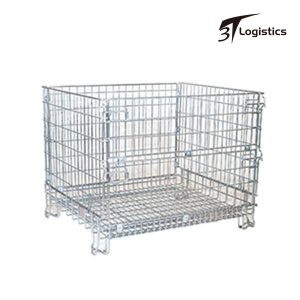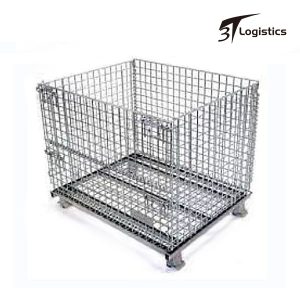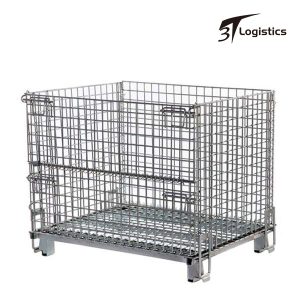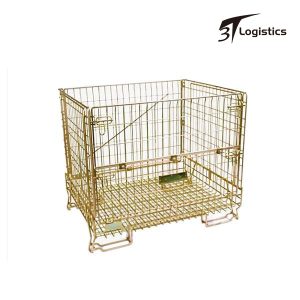
Introduction:
Every warehouse manager has the same thought: floor space is limited, so if you can stack higher, you store more. But cage pallets aren’t magic—you can’t just pile them up as high as you want. Overstack and crush the bottom units, and that’s bad enough. But if a forklift brushes past and the whole stack comes down, you’re looking at a safety incident, not just a damaged pallet.
Through working with different warehouse and manufacturing applications, we have seen that stacking performance depends on much more than steel thickness. Customers who bought cheap cages only to have the base frames buckle within three months. And customers whose well-designed units are still in daily rotation after five or six years. The difference isn’t just a fraction of a millimeter of steel thickness. It’s whether the manufacturer actually thought through what “load capacity” and “stacking” mean in a real warehouse.
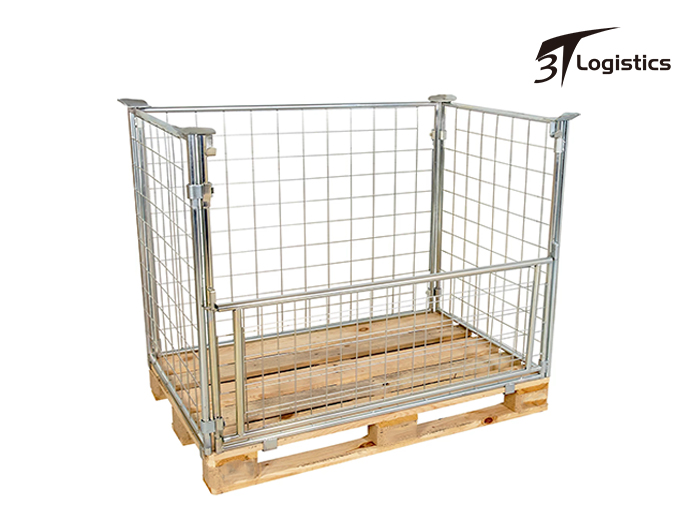
What Really Determines Stacking Height? It's Not Just Steel Gauge
A lot of buyers lead with: “How many layers can your cage pallet stack?” That’s a fair question, but it doesn’t have a single answer. It depends on what you’re storing, how you load it, whether you’re stacking in static storage or moving stacks with forklifts, and even how level your floor is.
But putting those usage variables aside, there are five specific design details that determine how high—and how long—a cage pallet can stack.
1. How the corner posts connect to the base.
Cheap designs often weld posts flat onto the top of the base frame. The entire load transfers through those welds. Put too much weight on top, and those welds either crack or pull the base plate out of shape. Better designs run posts through the base structure or seat them inside the frame so the load goes straight down to the floor—not through a weak joint.
2. Base frame stiffness. The base carries everything above it.
If you’re stacking three loaded cages on top, the bottom unit’s base has to support three times the single-unit weight. If the tubing is too thin or there’s no cross-support underneath, the middle of the base sags. Once it sags, the feet on the cage above don’t seat properly, and the next stack sits crooked.
3. Feet and locating features.
Stack stability depends on how well the feet engage with the frame below. Some designs just weld on four flat pads—they sit loose, wobble, and can tip if nudged. Good designs include recessed pockets or locating lugs that guide each cage into position and prevent sideways slippage.
4. Weld quality under repeated stress.
Poor welding practices can lead to cracks appearing around high-stress areas after repeated loading cycles. Not a steel problem—it’s a welding problem. Poor penetration, slag inclusion, or shallow weld profiles crack under vibration. This can happen with automated or manual welding; what matters is whether the manufacturer actually inspects their welds.
5. Wall thickness matched to your actual load.
This one’s straightforward. A cage built from 1.5mm tube won’t carry what a 2.0mm tube cage can. But thicker isn’t always better—heavier cages are harder to push and burn more fuel when moved. The right thickness depends on your weight requirements.
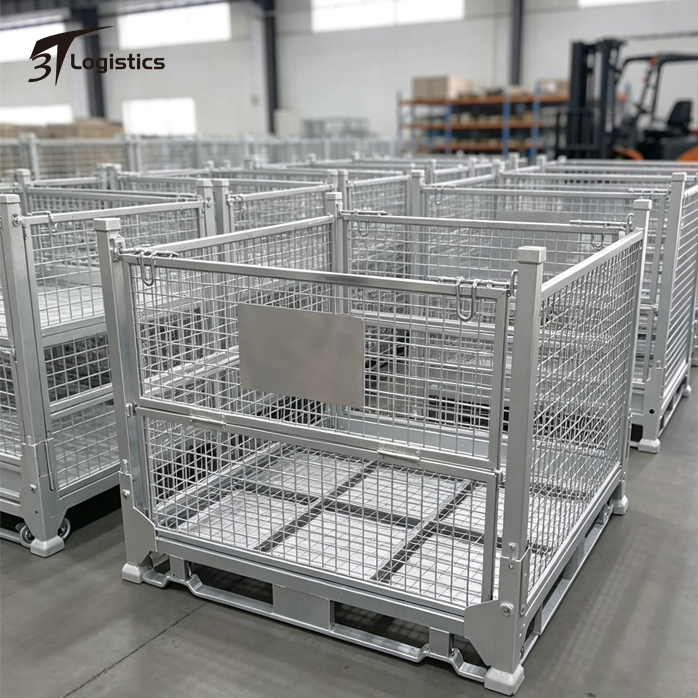
Why "4 Layers Fully Loaded" Is a Reasonable Industry Benchmark
If the load is spread evenly across the base and stays within the design weight, a properly engineered metal cage pallet can safely stack 4 layers high. Achieving four-layer stacking capacity requires proper load distribution, structural reinforcement, and sufficient safety margins.
Here’s the math: a loaded cage weighing 500 kg, stacked 4 high, means the bottom unit supports 1.5 tons above it. The base frame and corner posts have to be designed with enough margin to handle that without permanent deflection. Use the right material and the right structure, and it’s an achievable target.
But here’s the catch—that “4 layers” assumes even load distribution. If you dump a pile of loose parts in the center, or lay long heavy bars across just two support points, you concentrate all that weight on a small area. The base might not sag overall, but the local pressure can dent the floor plate or punch through the mesh. That’s why experienced logistics engineers often recommend a slip sheet or plywood panel under uneven loads—it turns point loads into distributed loads.
Empty Cages Can Stack Higher—But They Come With Their Own Headaches
Empty cages are lighter, so physically you can stack them higher. Compression stress on the bottom unit is minimal, and 6 to 8 tiers are common in many warehouses.
The problem is stability. Empty cages have a high center of gravity relative to their weight. A tall stack of empties behaves like a column of cardboard boxes—one nudge and the top ones shift. This is especially risky when the feet don’t lock into positive locating features. Forklift drivers reversing out of an aisle can clip a stack with the overhead guard, and down comes the top cage.
That’s why good design for empty stacking isn’t just about how many tiers you can reach—it’s about how to keep them straight and secure. Features like stacking lips, interlocking feet, or even strap slots make a real difference in daily handling. They’re easy to overlook during purchase, but they show up immediately in the warehouse.
What Happens When Cage Pallet Design Falls Short
In our experience, most failures fall into a few common patterns:
Posts bow outward.
After several stacking cycles, the posts start bulging in the middle. Top frames won’t close, and cages sit crooked. This usually points to undersized tubing or missing horizontal bracing.
Base corners curl up.
The center of the base sinks, forcing the corners to lift off the floor. The cage rocks, and forklift tines won’t slide underneath cleanly.
Weld cracks propagate.
A hairline crack at a joint grows with every load cycle. Once it starts, it doesn’t stop—welds don’t heal themselves.
Feet deform or detach.
Feet welded to the base can tear off. Bolt-on feet can loosen or shear. Either way, once the feet fail, the cage becomes unstackable.
A Practical Checklist for Buyers
If you’re evaluating cage pallet suppliers, skip the marketing brochures and focus on these points:
- Test the base flex yourself. Put a heavy sample load in the cage and watch the base. Does it visibly sag? If possible, stack two units and check whether the feet align squarely with the locating features.
- Ask how they control welding quality. Don’t accept “we have good quality”—ask specifically if they perform weld inspection, what method they use, and how often. A vague answer is a red flag.
- Ask about customization capability. A supplier who only sells standard sizes probably can’t adapt to your load dimensions or weight. The ones who ask about your product size and weight—and suggest changes to tubing, cross-members, or mesh spacing—actually understand engineering.
- Look at the welds on sample units. Are they consistent? Any pitting, undercut, or spatter? Good appearance isn’t everything, but consistent welds usually correlate with consistent manufacturing.
- Ask about repairability and spare parts. Feet get damaged. Hinges wear out. Can you order individual components, or do you have to buy entire new cages? A supplier who stocks spares saves you money in the long run.
At the End of the Day, Cage Pallets Are Long-Term Assets
Cage pallets aren’t disposable. They go through thousands of stacking cycles, miles of forklift travel, and years of warehouse conditions. The purchase price matters, but the real metric is how many years of reliable service you get for that price.
As a manufacturer, we design our cages for the conditions our customers actually operate in. But we don’t assume one model fits everyone. That’s why we spend time understanding your specific application—what you’re handling, how heavy it is, how you move it, and how high you stack—before making recommendations. Because once those cages hit your floor, performance speaks for itself.
3T Logistics manufactures metal cage pallets, stillages, and handling equipment with real-world stacking performance built in. If you’re dealing with stacking stability issues or trying to improve warehouse utilization, bring your load specs and operating conditions to us. We’ll help you find a solution that actually fits your operation.