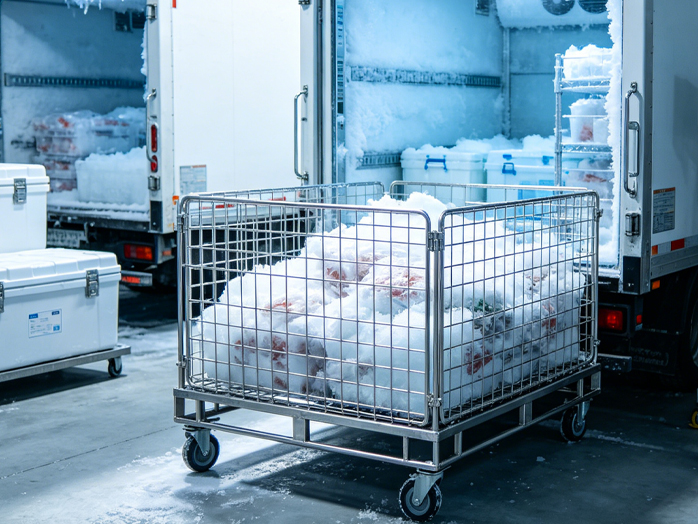
As global food trade continues to expand and consumer demands for food safety become increasingly stringent, cold chain logistics is undergoing a profound transformation—from mere “temperature control” to “end-to-end safety assurance.” Against this backdrop, stainless steel wire containers are emerging from behind the scenes to become a critical asset in high-end food cold chains. Recently, as a number of international logistics giants accelerate their deployment of food-grade stainless steel containers, an industrial revolution centered on efficiency, safety, and asset circularity has quietly begun.
1. Material Transformation:
Breaking the Safety and Durability Deadlock of Traditional Cold Chain Containers
In traditional cold chain scenarios, wooden pallets, plastic totes, and corrugated cartons have long dominated the landscape. However, under low-temperature, high-humidity conditions, these materials present persistent challenges:
Hygiene Risks:
Wood is prone to mold and bacterial growth; plastics become brittle at low temperatures, and the scratches on their surfaces form biofilms that serve as breeding grounds for microorganisms.
Waste and Environmental Impact:
Single-use cartons generate high carbon emissions and lack the structural strength needed for automated high stacking.
Stainless steel addresses these challenges head-on:
304/316 stainless steel remains structurally stable in environments ranging from -20°C to -40°C, with no risk of harmful substance migration. Its non-porous surface can withstand high-pressure steam sterilization, fundamentally eliminating the risk of cross-contamination.
While stainless steel is heavier than plastic, modern manufacturing techniques have achieved a balance between durability and transport energy consumption through high-strength, lightweight designs. In sectors such as fresh e-commerce, imported meat, and pharmaceutical-grade ingredients, stainless steel containers have become the “physical hard shield” for food safety.
2. Structural Transformation:
From "Loading Container" to "Unitized Intelligent Logistics System"
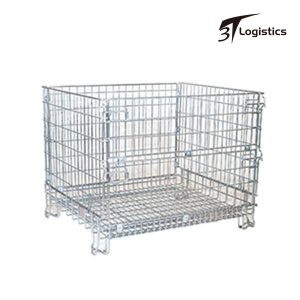
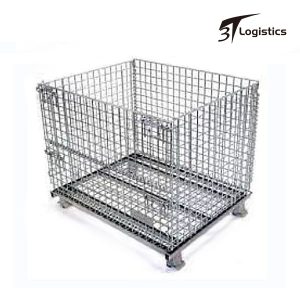
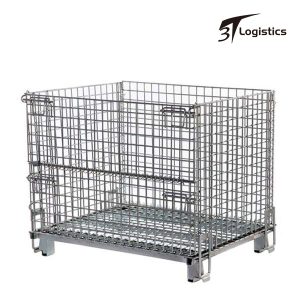
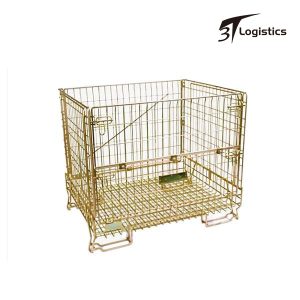
The core value of stainless steel wire containers lies in their modular and standardized design, which is driving the evolution from fragmented manual handling to efficient unitized logistics.
Space Optimization:
Most modern stainless steel wire containers feature a collapsible design, reducing return space by up to 75% when empty. For cross-regional reverse logistics, this is a technical prerequisite for economic viability.
Automation Compatibility:
Standardized dimensions enable seamless integration with Automated Storage and Retrieval Systems (AS/RS) and shuttle systems. Unlike easily deformable cartons, wire containers provide stable gripping points and positioning accuracy for automated equipment.
Temperature Continuity:
The mesh structure ensures efficient cold air circulation, enabling uniform cooling of goods. In addition, operators can visually inspect contents without opening the container, effectively reducing temperature fluctuations.
Research indicates that in closed-loop supply chains encompassing “pre-cooling at origin – long-haul transport – warehousing,” the introduction of stainless steel wire containers can improve loading and unloading efficiency by over 30% and reduce product damage rates by nearly 15%, truly achieving “unit load integrity” throughout the journey.
3. Compliance and Economics:
A Deep Analysis of Lifecycle Cost
As food safety regulatory frameworks evolve, the “verifiability” of containers has become a core competitive advantage for enterprises.
Regulatory Support:
Unlike plastic containers, which often struggle to provide documented cleaning histories, stainless steel containers are heat-resistant, corrosion-resistant, and support a closed-loop management system of “batch-by-batch cleaning and recording.” They serve as a significant advantage in obtaining international certifications such as BRC and IFS, and can effectively reduce customs clearance times.
Cost Reality:
Although the initial purchase cost is higher, the service life of stainless steel containers typically exceeds ten years. Financial models show that in high-frequency, long-distance scenarios with robust asset management capabilities, the total cost of ownership for stainless steel containers often becomes favorable within three to five years—through reduced packaging material expenses, lower product damage, and higher residual value recovery.
Special Note:
To mitigate the risk of asset loss, leading companies typically adopt deposit systems or rental-and-return models, supplemented by digital tracking to ensure asset visibility.
4. Outlook:
The Integration of IoT Technology and Standardization
Despite their clear advantages, the widespread adoption of stainless steel wire containers still faces challenges, including high initial investment and the complexity of empty container recovery.
Digital Evolution:
By embedding RFID tags and temperature-humidity sensors, stainless steel wire containers are evolving into “intelligent data terminals.” The location, cleaning history, and internal temperature and humidity of each container can be tracked in real time. This “digital identity” not only enhances asset security but also makes cold chain transparency a practical reality.
Standardization Empowerment:
As relevant industry group and sector standards mature, the challenge of interchangeability between enterprises will gradually be resolved. In the future, “pooled circulation platforms” based on standardized container specifications will become feasible, further lowering the barrier to entry for individual companies.
Conclusion
In the next five years, driven by tightening environmental policies and the proliferation of IoT technology, stainless steel wire containers will gradually evolve from a “high-end option” in niche segments to a “standard configuration” in food cold chain infrastructure. They are not merely physical storage tools but a critical link connecting food safety, operational efficiency, and green sustainability. This transformation is profoundly defining the future of the cold chain—safer, more efficient, and more sustainable.