I. Common Hazards of Damaged Post Pallets
1. What are the main manifestations of post pallet damage?
Post pallet damage usually manifests in four forms: bending or denting of posts, cracking of welds at connection points, warping or deformation of the bottom pallet, and severe corrosion of the steel surface. This damage leads to a decline in the overall structural strength of the post pallet. When using such equipment, the load-bearing capacity is significantly reduced, and it is difficult for operators to directly judge the remaining safe load value from the appearance.
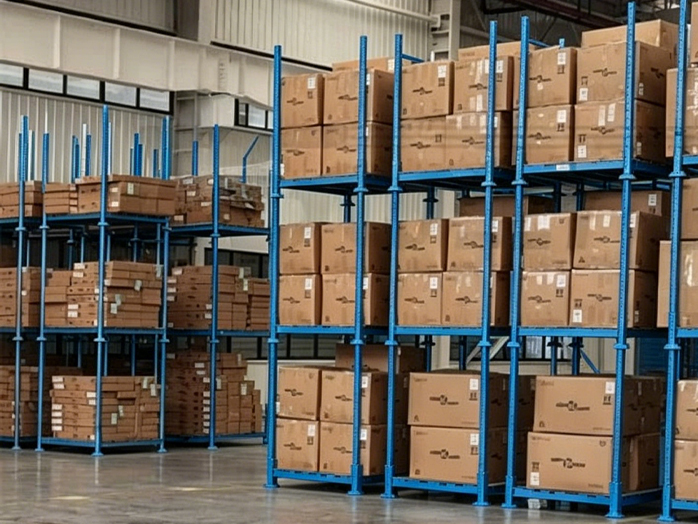
Bent Posts
Posts show visible bending or denting, losing their original straightness.
Cracked Welds
Openings or cracks appear in the welds between the posts and the base, or between the posts and horizontal braces.
Deformed Bottom Pallet
The base plane is warped, dented, or twisted, making it impossible to place steadily.
Severe Corrosion
Peeling rust scales, holes, or a significant reduction in section thickness appear on the steel surface.
2. What risks are posed by bent posts?
Bent posts destroy the original load-bearing structure, preventing the load from being transmitted vertically to the ground. In this state, the post pallet is prone to lateral instability, leading to the collapse of the entire stack of goods. In dynamic scenarios, such as during forklift handling, a bent post may suddenly break. This directly causes goods to fall, injuring surrounding personnel or equipment.
3. Why is weld cracking dangerous?
Welds are the key connection points between the posts and the base, and between the posts and horizontal braces. Once cracked, the rigid connection between the components of the post pallet is lost. In a stacked state, an individual post may shift outward or inward. This causes the goods on the pallet to lose support, triggering a local collapse. In severe cases, the entire post pallet can disintegrate instantly.
4. What problems are caused by the deformation of the bottom pallet?
Deformation of the bottom pallet prevents the post pallet from being placed steadily on the ground or on racks. A tilted base causes uneven load distribution, accelerating the fatigue failure of posts and welds. Additionally, a deformed base is prone to jamming when forklift forks are inserted. This increases operational difficulty and raises the risk of collisions and tip-overs.
5. How does severe corrosion weaken structural safety?
Corrosion reduces the effective section thickness of the steel, lowering the post pallet’s resistance to bending and compression. Areas with severe corrosion are usually the regions under maximum stress, such as the connection between the post root and the base. When the corrosion depth exceeds 20% of the original thickness, the structural safety margin drops significantly. Corrosion is particularly prominent in damp or corrosive warehouse environments.
6. What types of accidents can be caused by using damaged post pallets?
According to industry statistics, there are four main types of warehousing accidents related to post pallets:
Type 1
Goods collapsing and injuring people. This has the highest proportion and usually occurs during stacking operations or forklift driving.
Type 2
Forklift overturning. When a post pallet suddenly deforms or disintegrates on the forks, the load center of gravity of the forklift shifts violently.
Type 3
Obstruction of fire evacuation. Collapsed post pallets and scattered goods can block escape routes, leading to serious consequences in emergencies like fires.
Type 4
Chain reaction collapse of adjacent racks. The failure of one post pallet can affect the entire storage area like a row of dominoes.
II. How to Systematically Inspect Post Pallets
1. Which parts should be focused on during daily visual inspections?
Operators should check for obvious bending or denting of the posts before daily use. Focus on checking for visible cracks at the welding points between the roots of the four posts and the bottom pallet. Check the surface for large areas of peeling rust or perforations. Simultaneously, confirm that all horizontal and diagonal braces are in place and not deformed. If any abnormality is found visually, the post pallet should be stopped from use immediately.
2. What steps are included in a detailed monthly inspection?
A detailed inspection should be conducted monthly by a dedicated safety officer using a straightedge, weld gauge, and flashlight. Measure the verticality of the posts; a deviation exceeding 10 mm/m should be judged as unqualified. Use a weld gauge to measure the width of weld openings; those greater than 0.5 mm with a length exceeding 10% of the total weld length must be scrapped. Check the flatness of the bottom pallet; it cannot be used if warping in any direction exceeds 15 mm.
3. How to check for hidden damage?
Hidden damage includes minute fatigue cracks, internal corrosion, and metal deterioration under plastic or rubber coatings. A small hammer can be used to lightly tap the welds and base metal; a crisp sound is normal, while a dull sound may indicate internal delamination or corrosion. For coated parts, the coating must be stripped away for inspection. Magnetic particle testing or ultrasonic thickness gauges can be used for in-depth detection in high-value or high-risk scenarios.
4. How should inspection records be managed?
Each post pallet should have a unique ID number and an inspection file. Records should include the inspection date, the inspector, problems found, treatment measures, and re-inspection results. For repaired post pallets, the repair part and the repair unit must be noted. All records should be kept for at least two years. Electronic records are more convenient for data analysis and trend warnings.
5. How do inspection cycles differ in various environments?
Environmental factors have a significant impact on the degradation speed of post pallets.
| Operating Environment | Daily Visual Inspection | Detailed Inspection | Special Requirements |
| Dry, Ambient Temperature, Light Load | Once daily | Once monthly | None |
| Humid, Corrosive, Heavy Load | Once daily | Once weekly | Increase frequency of corrosion checks |
| Cold Storage (Below -18°C) | Every entry/exit | Once monthly | Check for material brittleness |
| Outdoor/Open-air | Before and after each use | Every two weeks | Check for UV and rainwater damage |
6. Under what circumstances must a post pallet be scrapped immediately?
A post pallet should be scrapped if any of the following occur:
- Any post bending deformation exceeds 5 degrees or dent depth exceeds 10% of the post width;
- Any two welds crack simultaneously or a single weld crack length exceeds 50 mm;
- The bottom pallet has penetrating corrosion or fractures;
- The post pallet has experienced an overload event of 30% or more;
- After repair, the strength cannot be restored to 80% of the original design value. Scrapped items should be cut and destroyed to prevent accidental misuse.
III. Preventive Measures and Safe Operating Procedures
1. How to use post pallets correctly to avoid damage? The "Five Prohibitions" for Correct Use:
Prohibition 1: Do Not Overload.
Before use, the weight of the goods must be checked against the rated load range of the post pallet. The rated load is usually marked on the upper part of the post or the side of the bottom pallet; if blurred, it should be re-sprayed before use.
Prohibition 2: No Impact.
It is forbidden to throw post pallets from heights or use forklifts to push post pallets that are already in place. Lateral impact is far more destructive to welds than vertical loads.
Prohibition 3: No Misaligned Stacking.
When stacking, the four corners of the upper post pallet must drop accurately into the positioning slots of the lower post pallet. Misaligned stacking concentrates the load on individual posts, making crushing very likely.
Prohibition 4: No Mixed Use or Mixed Stacking.
Post pallets from different manufacturers, batches, or models may vary in size and strength; they should not be mixed for stacking or repair.
Prohibition 5: No Unauthorized Welding Repairs.
Any temporary on-site spot-welding of post pallets is absolutely prohibited. Professional refurbishment by the factory or qualified units is allowed (and requires testing), but repaired units must not be used in original rated load scenarios unless they pass rigorous load testing and are signed off by an engineer.
2. How can warehouse layout reduce the risk of post pallet damage?
Set up crash bollards to protect post pallets at the edges of storage areas. Aisle widths should meet the minimum turning radius of the forklift plus a 0.5-meter safety margin. Install wide-angle mirrors and warning lights at turns. Draw clear isolation lines on the ground for work areas and walking zones. The ground in the post pallet storage area should have sufficient bearing capacity and be level; uneven ground will accelerate the deformation of the bottom pallet.
3. What should personnel training include?
Module 1: Identification Ability
Training includes how to read the rated load labels of post pallets, how to distinguish different models of post pallets, and how to identify the four main types of damage: bending, cracking, corrosion, and deformation.
Module 2: Inspection Skills
Master the standard process and judgment criteria for daily visual inspections, understand the tools and methods used in detailed monthly inspections, and clarify the reporting process and temporary disposal measures after damage is discovered.
Module 3: Operating Standards
Learn the safe coordination of forklifts and post pallets, including fork insertion depth (must be fully inserted into the base), confirmation actions before lifting (shake gently to check for hooking), and alignment methods during stacking.
Module 4: Emergency Response
Master escape routes in the event of cargo collapse, avoidance postures (stay away from the direction of collapse, find solid cover), and simple rescue methods (do not blindly move cargo pressing on people; use jacks to lift). All training should have written and practical assessments. Those who pass are issued an operation permit, and re-training and qualification reviews are conducted annually.
4. What are the restrictions on maintenance and refurbishment?
Only qualified repair units can perform welding repairs on post pallets. After repair, a load test must be conducted at 1.25 times the rated load, maintaining pressure for 10 minutes without permanent deformation. It is forbidden to use temporary measures such as self-tapping screws or wire binding instead of formal welding. Refurbished items should be re-sprayed and clearly marked with the rated load and refurbishment date.
5. How to establish an effective safety culture?
Management should incorporate post pallet safety into performance appraisal indicators. Establish a “Safety Snapshot” reward mechanism to encourage employees to report hazards. Hold a monthly safety analysis meeting to report inspection data and accident cases. Display scrapped post pallets in the training room as warning materials. Safety investment should prioritize solving high-frequency problems found during inspections.
6. How should post pallet-related accidents be considered in emergency plans?
Plans should include support and lifting methods for when people are trapped by collapsed goods. The site should be equipped with hydraulic jacks, cutting equipment, first aid kits, and stretchers. Simulate scenarios where forklift collisions with post pallets lead to chain reaction collapses during drills. Clarify communication methods and the route to the nearest hospital. Organize a practical drill involving post pallet accident disposal every six months.