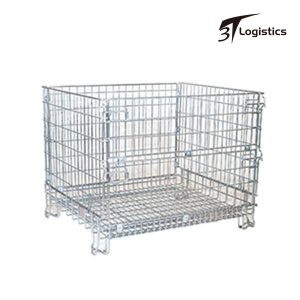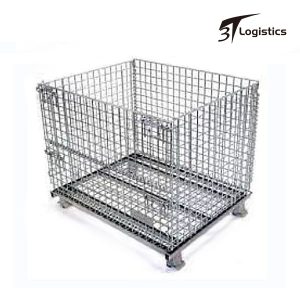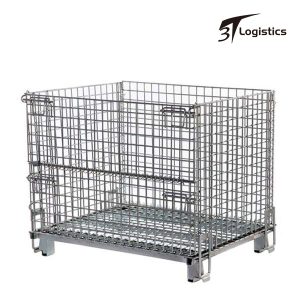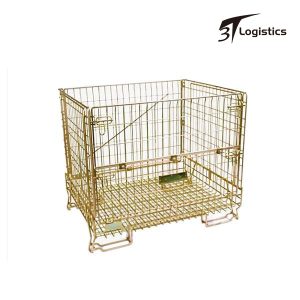
As land costs continue to climb and supply chain agility requirements become increasingly stringent, “seeking space upward” has become a core strategy for overcoming efficiency bottlenecks in warehousing. Driven by the pursuit of ultimate inventory turnover and space utilization in e-commerce, manufacturing, and retail, stackable cage pallets are evolving from traditional loading containers into critical modular components for building high-density, highly flexible 3D warehouses.
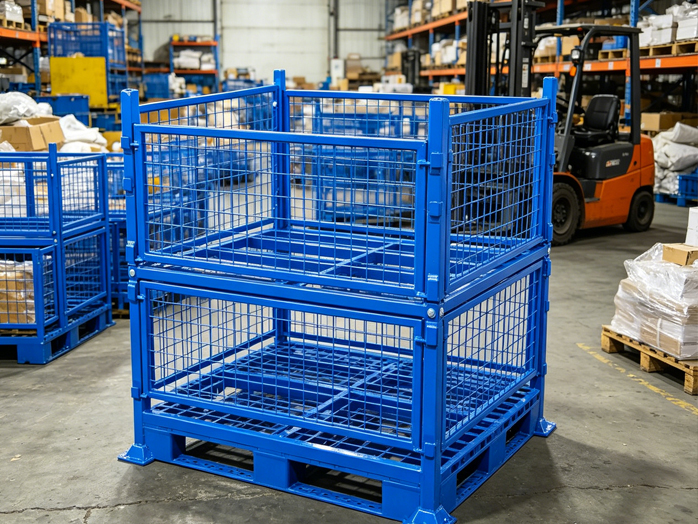
I. The Dilemma of Traditional Warehousing: Wasted "Cubic Space"
For a long time, traditional warehousing has faced a double bind: the high cost of horizontal expansion versus vertical space utilization rates that often fall below 40%. Traditional models reveal significant shortcomings across multiple dimensions:
The "Fear of Heights" in Floor Stacking
The height of bulk floor stacking is limited by the compressive strength of the goods themselves. Bottom-layer items are prone to deformation or collapse, leaving vast amounts of redundant overhead space unused.
Wasted Space in Fixed Racking
Racking layouts require permanent, wide aisles for forklifts. Furthermore, their fixed steel structures make it difficult to adjust dynamically to SKU fluctuations, leading to rigid warehouse layouts.
Inconsistent Packaging Specifications
Managing pallets and cartons of varying sizes is difficult, leading to unstable stacking and significant safety hazards.
Warehouse managers urgently need a storage solution that ensures safe high-stacking while allowing for rapid turnover and flexible layouts.
II. Structural Innovation: How Stackable Cage Pallets Break Density Barriers
Designed with high-strength steel and a modular approach, stackable cage pallets offer core advantages in:
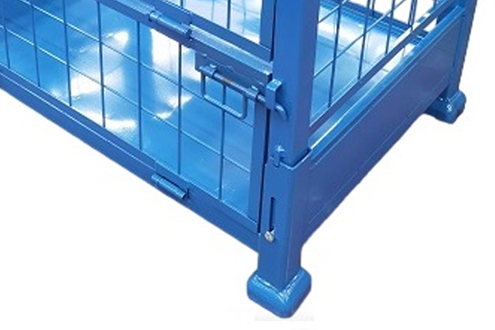
Vertical Expansion and Load Distribution
Utilizing four-corner posts and interlocking mechanisms, the load is transmitted directly through the reinforced posts to the ground. Goods inside the cage do not bear the weight of the upper layers. This mechanical advantage allows for stable stacking of four to six layers, safely supporting loads ranging from 500kg to 2,000kg per unit.
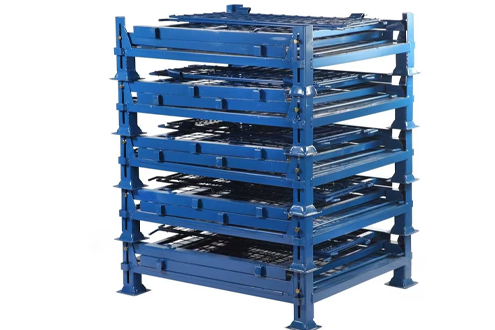
Collapsibility for Reverse Logistics
When empty, these cages can be folded for storage, saving approximately 70% of idle space and significantly reducing return transport costs.
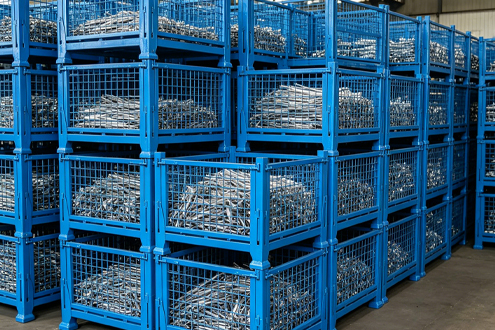
Scientific Alignment with Floor Loading
Achieving high-density stacking requires a synchronous evaluation of Floor Load Capacity (N/m²). Through specialized foot design, pressure is distributed evenly, ensuring that vertical space utilization is doubled without exceeding the structural safety limits of the warehouse floor.
Case Study: A major automotive parts supplier increased its line-side storage density by 180% by introducing stackable cages, releasing 3,000 square meters of operational area and improving production line feeding efficiency by 35%.
III. Safety and Intelligence: From Manufacturing Precision to Automated Integration
High-density storage must be built on the foundation of manufacturing precision. While traditional floor stacking risks damage due to pressure, the frame structure of stackable cages ensures the safety of the cargo. More importantly, modern cages are accelerating their integration with automated equipment:
High-Precision Interfaces
Stacking feet and positioning slots are precision-calibrated to integrate seamlessly with AGVs (Automated Guided Vehicles), four-way shuttles, and stacker cranes.
Smart Identification
Integrated RFID tags enable real-time data linkage with WMS (Warehouse Management Systems).
Turnover Logic Optimization
To solve the “difficulty of retrieving bottom items” in high-density stacks, the WMS employs ABC classification management. Long-tail inventory is stacked in higher tiers, while high-turnover goods are placed in easily accessible positions, balancing storage density with picking efficiency.
IV. Cost-Benefit: Leading in Total Cost of Ownership (TCO)
From an economic perspective, the value of cage pallets should be measured by their lifecycle benefits rather than just the initial purchase price:
Asset Flexibility
Unlike fixed racking, cages require no large-scale civil engineering and are highly mobile, allowing for rapid relocation as business needs change.
Packaging Substitution Benefits
With a lifespan of over ten years, the long-term cost of steel cages is significantly lower than one-way wooden pallets or cartons. While the initial investment is higher, the recurring costs for packaging and waste disposal can be reduced by over 30% annually through circular use.
Sustainability
Materials are 100% recyclable at the end of their service life, aligning with green logistics initiatives.
V. Industry Expansion: From Auxiliary Tools to Strategic Resources
Today, the application of stackable cages has moved beyond manufacturing into diverse scenarios:
Cold Chain
Corrosion-resistant designs allow for high-density, ventilated storage in refrigerated environments.
Pharmaceuticals
Closed-structure cages meeting GSP standards ensure the integrity and safety of medical supplies.
Cross-border E-commerce
Facilitating integrated “full-cage inbound, storage, and outbound” operations.
3PL (Third-Party Logistics)
Modular units adapt to the dynamic zoning needs of multiple clients and diverse product categories.
This trend reflects a fundamental shift in industry perception: cage pallets are no longer viewed as low-value auxiliary tools, but as strategic resources for optimizing the Return on Assets (ROA) of the supply chain.
VI. Future Outlook: The Steel Phalanx in a Digital Twin Environment
Looking ahead, cage pallets will feature built-in sensors to report real-time location, weight, and fill rates. In a Digital Twin interface, managers will remotely dispatch cage movements and dynamically optimize stacking layouts.
In an era where every square inch is at a premium, maximizing warehouse cubic space is no longer just a hardware challenge—it is a systematic engineering feat merging structural mechanics, high-precision manufacturing, automated algorithms, and sustainable value. These stacked steel phalanxes are redefining the new normal of high-density storage.
Conclusion
As global supply chains undergo rapid restructuring, the pursuit of extreme storage density will continue to drive innovation. The stackable cage pallet, in its understated yet critical role, provides the solid, flexible, and evolvable foundation for this revolution in spatial efficiency. In the future warehouse, where every inch is meticulously calculated, these stacked formations will write the next chapter of high-density storage.